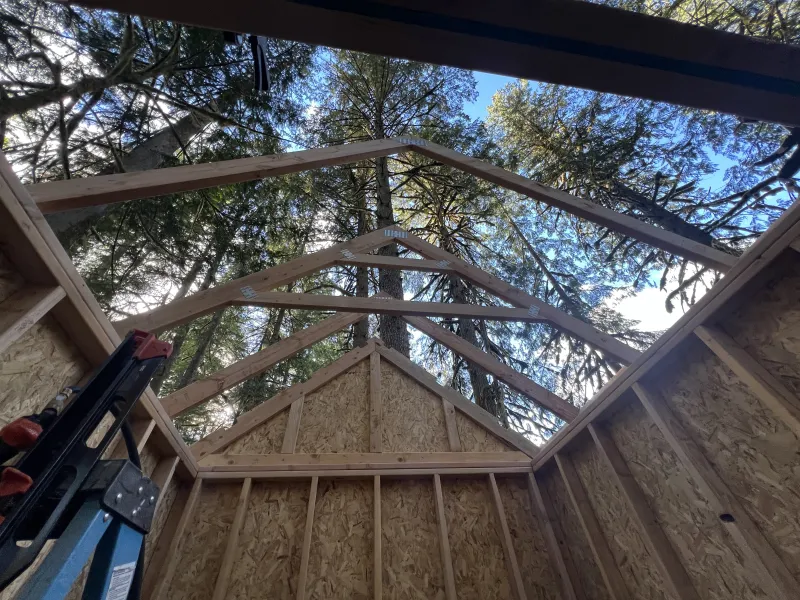
Shed Building Codes in Skagit County
Skagit County allows permit-exempt sheds up to 200 square feet — but the county's exemption comes with more conditions than most. Your shed can't be in a flood zone or critical area buffer, can't have plumbing unless the water source is approved, and the county limits exempt buildings to one per 5 acres (max 4 total). Setbacks vary by zone, with typical side setbacks of 8 feet that can drop to 3 feet for accessory buildings under 1,000 square feet and 16 feet tall. The Skagit Valley's flood risk adds another layer — if you're in a Special Hazard Flood Area, you'll need a separate flood permit even for an exempt structure.
Building Codes & Permits in Skagit County
| Shed Permit Rules | Unincorporated Skagit County |
|---|---|
| Max Shed Size (No Permit) | 200 sq ft |
| Max Shed Height (Overall) | Per zoning district* — typically 30–40 ft |
| Setbacks (Side/Rear) | 8 ft side / 10 ft rear typical — 3 ft reduced for accessory ≤1,000 sq ft and ≤16 ft† |
| Setbacks (Front) | 25 ft typical — check your zone |
| Max Exempt Buildings | 1 per 5 acres (max 4 per parcel) |
*Skagit County does not publish a specific overall height for permit-exempt sheds. Zone maximums (typically 30–40 ft) apply to all structures. For permit-exempt one-story structures, IRC defaults apply: 10 ft eave height.
†A 3-foot side/rear setback is permitted for nonresidential accessory buildings under 1,000 sq ft and 16 ft tall when the structure is at least 75 feet from the front property line or there is a rear alley.
Builder's Notes — Skagit County
- Setbacks (SCC 14.16): Standard setbacks vary by zone. Most residential zones require 8 ft side and 10 ft rear, with a reduced 3-ft setback available for smaller accessory structures (≤1,000 sq ft and ≤16 ft) that are 75+ feet from the front property line.
- Flood Zones: The Skagit Valley is one of Washington's most flood-prone areas. If your property is in a Special Hazard Flood Area, you'll need a flood permit even for an otherwise exempt shed. Properties in a designated floodway cannot place exempt structures at all.
- Critical Areas: Exempt structures cannot be placed within a defined critical area or its buffer unless separately approved. Check the Skagit County iMap for critical area overlays on your parcel.
- Utilities: Plumbing is not allowed in exempt structures unless the water source is approved. Heating requires meeting the Washington State Energy Code and obtaining a mechanical permit. Electrical work always requires a separate trade permit.
- Exempt Building Limit: Skagit County limits exempt buildings to one per 5 acres, up to a maximum of 4 per parcel. If you already have an exempt structure, additional buildings require a permit.
- Building Separation: Accessory buildings must be at least 10 feet from each other and from the main building if detached.
Code Excerpts
SCC 15.04 — Permit Exemption for Detached Buildings (Amended IRC R105.2)
One story detached buildings 200 square feet or smaller are exempt provided: the building is not used for sleeping purposes; not placed within a defined critical area or its buffer; only one such exempt building is allowed for each 5 acres of any parcel property up to a maximum of 4 exempt buildings; the building is not located in a designated floodway; and no heating, unless meeting the Washington State Energy Code envelope insulation requirements and a mechanical permit is obtained.
View source →SCC 14.16 — Reduced Setback for Accessory Structures
A three-foot setback is permitted for nonresidential structures when the accessory building is a minimum of 75 feet from the front property line or when there is an alley along the rear property line, provided that the structure is less than 1,000 square feet in size and 16 feet or less in height.
View source →SCC 15.04 — Exemption Does Not Override Code Compliance
Permit exemption does not otherwise exempt the construction from the substantive standards of the codes, and unless otherwise exempted, separate plumbing, electrical, and mechanical permits may still be required for exempt items.
View source →Cities in Skagit County
Frequently Asked Questions
In unincorporated Skagit County, sheds under 200 sq ft (one story) generally do not require a building permit per SCC 15.04 (https://www.codepublishing.com/WA/SkagitCounty/html/SkagitCounty15/SkagitCounty1504.html). However, the exemption has conditions: no sleeping use, not in a floodway or critical area buffer, and limited to one exempt building per 5 acres (max 4). If your property is in a Special Hazard Flood Area, a flood permit is still required.
200 sq ft floor area per SCC 15.04 (https://www.codepublishing.com/WA/SkagitCounty/html/SkagitCounty15/SkagitCounty1504.html). Above that, a building permit is required through Skagit County Planning & Development Services (https://www.skagitcounty.net/Departments/PlanningAndDevelopment). The county limits exempt buildings to one per 5 acres, up to 4 per parcel.
Skagit County does not publish a specific height limit for permit-exempt sheds. Zone maximums (typically 30–40 ft) apply to all structures per SCC 14.16 (https://www.codepublishing.com/WA/SkagitCounty/html/SkagitCounty14/SkagitCounty1416.html). For permit-exempt structures, IRC defaults apply: 10 ft eave height. Accessory structures using the reduced 3-ft setback must be 16 ft or less. Look up your zone on the Skagit County iMap (https://www.skagitcounty.net/maps/imap/).
Setbacks vary by zoning district per SCC 14.16 (https://www.codepublishing.com/WA/SkagitCounty/html/SkagitCounty14/SkagitCounty1416.html). Typical residential zones require 8 ft side, 10 ft rear, and 25 ft front setbacks. A reduced 3-ft side/rear setback is available for accessory buildings under 1,000 sq ft and 16 ft tall when 75+ feet from the front property line. Accessory buildings must be at least 10 feet from other structures. Look up your parcel on the iMap (https://www.skagitcounty.net/maps/imap/).
Skagit County follows the International Building Code with local amendments in SCC 15.04 (https://www.codepublishing.com/WA/SkagitCounty/html/SkagitCounty15/SkagitCounty1504.html). Key shed rules: permit-exempt under 200 sq ft per amended IRC R105.2. One exempt building per 5 acres (max 4). Not allowed in floodways or critical area buffers without approval. No sleeping use. Setbacks per SCC 14.16 (https://www.codepublishing.com/WA/SkagitCounty/html/SkagitCounty14/SkagitCounty1416.html) — typically 8 ft side, 10 ft rear (3 ft reduced available). Electrical and plumbing always require separate trade permits.
Ready to Build in Skagit County?
Design your shed in 3D and get an instant quote.